Showing posts with label attributes. Show all posts

BJJ tips / attitude: Keep it playful. I think not!

At least not this summer.

Those who know me know I’m a huge fan of Ryron Gracie’s Keepitplayful philosophy, not just in training jiu jitsu but in life in general but recently, incidents have been happening around the gym that made me decide to conduct a jiujitsu experiment.

Martyn has often sited this Marcelo Garcia video when encouraging people to go harder more often. Go harder might be a bad description. I think he wants people to simply give their all. Leave their hat on the mat and all that jazz.


BJJ and the Cycle of Action


You didn't think Helio rolled competitively every day did you?

BJJ works, but that of course goes both ways.

When I’m rolling competitively I'm always initiating attacks. Always. It might feel like I'm just laying on you in side mount or just holding your head in my guard but believe me I'm actively working to kill your arms in the former and rocking your balance (kuzushi) in the latter to initiate a flower sweep or a back take. At the very least, I'm working to create a posture deficit to my advantage. This is something I've worked hard to develop over the past few years. To me, this is one of the strongest links between BJJ and MMA*.

But as I said above, this goes both ways. The other person is doing the same thing. They are constantly defending and negating my actions, trying to set up their own. This places the following three sets of demands on you:

Mental: As Saulo says in this clip, the only thing that differentiates us on the mat is the heart, and for this style of BJJ you need a huge heart. It's not easy. You're constantly working. Constantly flowing. Constantly in the moment.

Technical: You need to know your techniques inside and out. If your takedowns are getting stuffed and your passes ending with you getting swept then you will eventually stop doing them or at least hesitate to initiate them. Your momentum will be turned against you and you will start freezing.

Physical: I put this last because even though I acknowledge that BJJ, MMA or any combat sport places physical demands on you (strength, cardio, balance...etc.) these can never overshadow technical knowledge and having a big heart.

Start today. Grab a piece of paper and write down three attacks from each position you know and work out how to link them. The next time you roll competitively**, start from one of those positions and just machine-gun those 3 attacks in succession at your partner and watch your progress rocket***! Speed is not essential. Technical knowledge, heart and flow are.

----------------------
*Martyn, our coach at the LABS - FIGHTING FIT MANCHESTER, has always kept the MMA mindset with us. He couldn't care less if we ever compete (whether in gi-jiu jitsu, submission wrestling or MMA) or if we are just training for fun or self-defence. To him, you always keep to the positional strategy and hierarchy of BJJ.
**I don’t roll competitively often at all. I do it every week or two just to stay sharp and more nearer *the rare) competitions.

***Roy Harris wrote a classic article on Progress in Jiu Jitsu and the different belts.


----Did You Like This Article?--- Click here to add The Part Time Grappler to your Favourites / Bookmarks ---------------------------------

BJJ / Grappling Training: Attribute training vs Skill Training

Marcelo Garcia Vs Ricco Rodriguez (pic is borrowed)

There are many different aspects to getting more competent at a sport (BJJ, grappling and MMA included), but they can generally be grouped under three categories:

1. Sport-specific skills: In grappling that includes techniques such as the upa escape, the scissor sweep and the triangle choke.
2. Sport-specific attributes: In grappling that includes attributes such as sensitivity, timing, agility, coordination, recuperation and balance.
3. Sport-specific mental preparation: In grappling that includes survival in bad spots, working with the clock, patience, mental recovery between a succession of matches and dealing with pre-match nerves.

I believe that the general framework for these is the same whether you treat BJJ / Grappling as a sport (with a defined sportive career) or a martial art (a lifelong pursuit which may or may not have a strong competitive element). It is however true that the specifics of each will vary depending on your focus (event rules, match duration and opponent size & skill level may or may not be important to you).

What has become really interesting to me recently is what people choose to focus on*. I find it quite telling.


BJJ Technique: What makes a BJJ technique?

We hear sometimes that Brazilian or Gracie Jiu Jitsu has hundreds of techniques*. But what constitutes a BJJ technique? If you lift the hood on a sweep, a submission or even a positional escape what do you see?

Having done some research into what different black belts think** I propose the following components to a jiu jitsu technique:
  • Placement and Positioning
  • Mechanics
  • Attributes
  • Timing
Or PPMAT

Placement & Positioning: in Brazilian jiu jitsu, placement (your head and limbs) and Positioning (your body and angle) is not just where you put your grips, feet, head, limbs and hips, but also how you place them in relation to those of your opponent. Grappling is not a solo performance. My opponent could have the best P&P to do a butterfly sweep, kimura submission or armbar from closed guard but if I change my own P&P I could potentially ruin his set-up and technique. Learning as much as you can about optimal placement and positioning, both in offence and defence, will help you gain the most leverage when grappling.

Mechanics: when it comes to mechanics, Roy Harris is king! I remember reading an interview with August Wallén, BJJ black belt under Mr Harris and head of Shooters MMA amongst many other accomplishments, where he was talking about his influences and he brought up how Roy changed his view of the game to another technical level.


me and Mr Roy Harris after one of his seminars in Gothenburg, Sweden hosted by August. That's a Karate blue belt (and gi) so we're talking ol' skool!

Auxiliary Training and Brazilian Jiu Jitsu / Grappling


It's important to treat it as that: auxiliary. If the intensity, duration or frequency of there sessions has a negative effect on your performance in BJJ / grappling / MMA then you have gone too far. All types of exercise exert stress on your body and dig a proportionate hole into your recovery reserves and you need to weigh off that against the potential benefit that auxiliary training will bring you.

Keeping the above in mind, there is also a hierarchy in building the attributes that you need for grappling and BJJ:

1. Mobility.
2. Endurance.
3. Strength.

You simply need enough mobility to be able to perform all the fundamentals of your art Brazilian Jiu Jitsu. Find a simple and reliable programme to increase your range of motion in your wrists, shoulders, neck, lower back, hips and ankles and stick to it. A Yoga vinyasa (chain) like the Sun Salutation is excellent. Notice I didn’t say flexibility! Flexibility is awesome and I stretch loads every single day, but I do it because I enjoy it. For a dynamic art like Brazilian Jiu Jitsu (or any other martial art) you need to work on your joint mobility. Rotation work ala Pavel is the way forward.

Once happy with this basic level of flexibility it's time to work on your gas. Once again it's important to remember why you're doing this. This is nothing to do with your Lactic Acid Threshold. You're not aiming to become a long distance runner, or any kind of runner for that matter. Don't get overzealous and push past the lactic acid barrier. Keep the pace and intensity low and never allow these sessions to interfere with your ability to train your main sport and art. If anything, there sessions will help you move the blood around and flush any remaining lactic acid out of your grappling muscles, not generate some more!

Next on the agenda is strength. Once again, keep the goal in mind and don't train like a body builder or a power lifter. Focus instead on strengthening your back, core and legs and perhaps leave the holy bench press aside for a while. You want to be strong in the areas that end up carrying toe most tension and stress during grappling so you can stay healthy and grapple your whole life.


----Did You Like This Article?--- Click here to add The Part Time Grappler to your Favourites / Bookmarks ---------------------------------

Are we all created equal? A BJJ / MMA Perspective


Learning styles are often grouped into visual (show me), auditory/verbal (tell me) and kinaesthetic (let me have a go). You often hear that no one learning style is better or worse than the other and there is a lot of truth in that, but I believe the operative word here is "learning".

Last Friday I had another training session with my brother and he brought along two friends. One of them has been training at a DIY kinda place (training on carpet, instructor had learnt submissions off YouTube…you get the picture!) for a couple of months and to say the least he had a huge thirst for the sport. He asked me about armbars from the guard so I spent a few minutes showing him the basics. It took me 10 seconds to figure out he was a kinaesthetic learner: He looked at me with a big question mark on his face when I was trying to explain what he needed to do on his training partner (he kind of looked like a puppy trying to understand algebra). When I demonstrated the armbar on my brother he got much more excited but it didn't translate into any better performance (if anything, I think it confused him a little)

When I offered to demonstrate on him he jumped (literally) at the opportunity but he immediately pulled guard. He wanted to try it. He had had enough watching and listening. It was his turn and sure enough after a few gos and a few manual corrections from me he was doing alright armbars. All's well that ends well. But I couldn't stop thinking about two things:

1. If your instructor only has one styles of teaching and doesn't happen to match yours, you're screwed.
2. If you are a pure kinaesthetic learner, there's a strong probability you'll be a lousy instructor, at no real fault of your own.

Think about learning / teaching as a process of exchange and transfer. If words (verbal) and/or images (visual) are your currency you can exchange much more easily than if you need to feel something to truly understand it. Sure, you can learn the art and become excellent, maybe even the best at it. But to teach a verbal/visual learner something in words/images when your real forte is “feeling” is a difficult thing to say the least.


----Did You Like This Article?--- Click here to add The Part Time Grappler to your Favourites / Bookmarks ---------------------------------

The Manchester MMA Scene - Part II

 WOW!! What an amazing response the interviews received! Who knew people from places as far as New Zeeland and Argentina would be interested in the Manchester MMA scene! Many thanks to all who took the time to read (and even send emails!) my interviews with head coaches Mr Gavin Boardman - Manchester Predators MMA, Mr Matt Thorpe - 12Gauge MMA and of course our own Mr Martyn Cahill - The Labs - Fighting Fit.

Here is part II of the interviews.

What's your take on the athletes’ attributes (physical and mental)?

Gavin Boardman (GB):

That's a very vague question. Doesn't that cover everything?! The attributes are what make a fighter. We all learn the same things, and are generally coached the same way. Everything else then must be the attributes of the individual athlete. The success of a fighter is quite often very little to do with his/her coach. I take no credit for any wins, only responsibility for all losses.


Matt Thorpe (MT):

They are both an important part of making a fighter or competitor. I would argue that mental is more important than physical, if you have a weak mind it doesn't matter how technically brilliant or physically gifted you are you just aren't going to cut it! I have spent a lot of time working with sport psychologists when I was fighting so I know how important having a strong positive mind is. This is something we incorporate into a fighters training camp and is massively important during the warm up before a fight!!

The physical side of things are a little different there are many sides to it, obviously being gifted great athleticism is awesome but with time, effort and dedication any one can develop high levels of skill and compete at a high level. If we break down the physical attributes into striking, wrestling and grappling these need to be trained equally in order to become a complete fighter. I do believe though that you have to concentrate a lot on the glue in the middle which is the wrestling and clinch. Without this whether you are a striker or grappler you can't dictate where the fight takes place!! I also believe this to be the most tiring of the 3 aspects, with striking and ground work you have time for a breather where as the wrestling and clinch side of things as neither competitor has established dominance yet you tend to find it is like to bulls butting heads!! Which brings us to breaking down the physical side of things into strength, power and fitness again these are all massively important and should be incorporated into the competitors training plan with a proper periodized program.

Martyn Cahill (MC):

There are many different kinds of fighters in terms of their physical and mental approach to the sport. Some people are very aggressive and rely more on their natural attributes, some are more technical and reserved. It is impossible to say which is better, in the end it is all down to the individual. I think perhaps the most successful fighters are those that manage to find the right balance for them between the two extremes.


What are the most important 3? How are they trained best?

GB:

The most important is what many people refer to as gameness. The ability to step up no matter how tough the situation seems. To a large degree this can't be trained, you either have it or you don't. You can toughen up training with hard sparring, but once you get in the cage it might not be there for you.
Second, I would say the ability to learn. We are involved in such a complicated sport; there is so much to learn. And things change in this sport quickly. If you can’t get up there and then keep yourself there, you will struggle. The coach has a responsibility in ensuring he adapts his approach to the needs of the athlete, but again largely a natural ability.
The third, I will say is the ability to listen under pressure. Being able to filter out useless information and listen to a game plan is much harder than people think. It is important to zone in on your coach's voice in training sessions through the sounds of other people training and through the bad music, so that it is natural in competition.
If you are looking for physical attributes in the list, there importance varies along with the style and approach of the fighter. Also, it seems like I am saying that the most important attributes are natural and can't be trained. Well that's why coaches have less to do with a fighter’s success than some make out. All we do is make sure they are ready to compete, set out an appropriate game plan, and adapt that game plan as necessary.

MT:

Difficult question to answer really as everyone is different. As a coach you need to assess each individual separately and decide what they need to work on to improve and reach the goals they are striving for!

MC:

For me the most important attributes are a good work ethic, creativity and mental fortitude. Things such as technique and conditioning can be worked on but I think the attributes I chose have to already be within a person. There are just some things that you can't coach; of course they can be encouraged.
Creativity for example is simply developed by providing the athlete with the correct tools. That is why I focus on fundamentals and the principles behind the techniques and that's one of the reasons our club is called The Labs!

Do you see MMA is a stand-alone sport or as a hybrid of individually trained arts?

GB:

I see it as a stand-alone sport. As much as I love BJJ or Boxing, the techniques have to be adapted for MMA. The best fighters don't flow between different arts, all of these "arts" exist at once. You can't throw a boxers left hook while adjusting your base to a wrestler's stance to level change for a double. Left hook to double just happens from 1 stance and is a standard movement in MMA.

MT:

I see MMA nowadays as a stand-alone sport. Yes it takes a lot of different things from a lot of different arts but they still have to be tweaked in order to use them within MMA. Striking for MMA, Wrestling for MMA and groundwork for MMA are different to any of the individual sports and have to be trained accordingly.

MC:

MMA is to some extent still a group of individually trained sports. You still see guys going to train in Thailand on their Muay Thai or working with a conventional boxing coach or wrestling coach. I'm sure lots of people will disagree with me but I generally do not like this approach. I just think that too many adjustments have to be made for these systems to then be reincorporated back into an individual’s game. I prefer to work on striking that is going to facilitate my grappling or grappling that is geared towards allowing me to strike effectively. The ultimate goal is to achieve seamless transitions between the three elements of stand-up, clinch and ground.

I take it you watch a lot of MMA. What impresses you in a fight?

GB:

I generally have the same view watching any sport. I am impressed with technical ability and tactical awareness. In that respect I like my MMA as I like my football.

MT:

I do watch a fair bit of MMA, what probably impresses me the most in a fight is a well-executed gameplan. I have seen fights won by guys that shouldn't have won by a very cleverly executed gameplan. It is something that can be under utilised by fighters so it is impressive to see a coach and fighter develop a plan that wins them a fight.

MC:

I get impressed in MMA by lots of things. The bravery and heart of a lot of these athletes is amazing. The amount of hard work and sacrifice they are willing to put into their preparation is second to none. I really appreciate a technical fight; I'm not a great fan of slugging it out.

How much of a role does diet play?

GB:

Diet is a major part of any fighter's success. Especially with the importance of weight cutting, and coming in as heavy as possible at the weight while maintaining optimum performance. Also, training day to day requires a focus on diet that most of us can't get close to.

MT:

Correct nutrition plays a massive role in your fighters conditioning it can have a massive impact improving their overall performance. I have spent a lot of time studying sports nutrition and it is something that I sit down with all my fighters and discuss, putting a proper plan in place. Nutrition is a subject all coaches and fighters should have knowledge of especially in a sport that is so heavily full of weight cutting, if this is done incorrectly it can have a very negative impact on your fighters performance and can be extremely dangerous.

MC:

First of all I'll say that I am not an expert in nutrition so my opinion is just that, an opinion. I imagine that diet plays a huge role in the preparation of any athlete. Not only for the repair and recovery of the body but also to maintain weight at a chosen level and to provide adequate energy during training. We have far more qualified people at our gym to discuss such matters so I will leave it to the experts.


Share with us a funny training anecdote or story.

GB:

Have you heard the one about the black belt and the trannie......lets leave that for another day.

MT:

Recently I brought my coach and good friend Aaron Chatfield in to teach a session on elbows. After demonstrating a technique he left the guys practicing, as they where doing this he was explaining how effective an accurate elbow can be and that it will slice you open like a razor. As this was occurring one of my students proceeded to miss the pad completely landing the elbow perfectly down the forehead of his partner slicing him open, this proceeded to piss blood all over the floor and his face my coach then turned around and said "See, Lethal!!". I had to take him home so that his wife could take him to hospital where he had to have 6 stitches to repair the damage.

MC:

Hmm nothing really springs to mind regarding a funny training anecdote. All the guys at the gym are really nice people, we all get on well and the atmosphere is very relaxed. People are constantly joking around and giving each other a hard time so it's hard to select on particular instance.


Finally, where and how can people get hold of you?

GB:

In the gym is the easiest place, alternatively my contact information is on the Predators website.

MT:

You can check out the clubs website and email me at matthew.thorpe@12gaugemma.com

MC:

Our BJJ-No gi-MMA classes are at the Labs – Fighting Fit Manchester. You can find us in city centre just down the road from the Urbis and Victoria train station. This is our Google-Map location and you can also find us on Facebook.

Once again, many thanks guys!


What an awesome bunch. If you are into MMA and you live in Manchester (or just visiting) then get in touch with Gavin, Matt or Martyn and drop down for a BJJ, No-Gi or MMA session or two. Who knows, you might even like it!

The Manchester MMA scene is in good hands.


----Did You Like This Article?--- Click here to add The Part Time Grappler to your Favourites / Bookmarks ---------------------------------

The Manchester MMA Scene - Part I

As I mentioned in a previous post, I’ve conducted interviews with the head coaches from a few Manchester based MMA clubs gyms and academies. They have been very generous with their time and the interviews were quite an interesting read, I’m sure you will agree. What I have done now is mixed these interviews around so rather than a full interview with one MMA coach, followed by the next and so on I will post the questions and then give you each coach’s own perspective, pinning the different answers against each other. I hope you like that format better. Here is part I of the interviews.

The coaches featured in this interview are Mr Gavin Boardman - Manchester Predators MMA, Mr Matt Thorpe - 12Gauge MMA and of course our own Mr Martyn Cahill - The Labs - Fighting Fit.


Hi guys, please introduce yourselves to the readers and give us an overview of your Martial Arts / Coaching Background

Gavin Boardman (GB):

I am a full time MMA Coach, and Head Coach of Predators Gym in Manchester. I have been coaching full time since about 2002 I think, working at Defence Unlimited, which then became SBG. I started Predators in 2007, where we have been relatively successful in a short period, with several titles and 3 pro fighters ranked consistently in the British top 10.
I initially started training traditional martial arts, like many people, when I was a child. I jumped between different systems for years until starting to train more seriously in 1996, when I was training JKD under Steve Powell and then Karl Tanswell. My training became more geared towards MMA in 1998. Most of my coaching history is based around practical experience, and I have been lucky enough to train with some great coaches. I have always approached what I coach as a sport as opposed to a "Martial Art", and I have done a great deal of research into the coaching methods of many sports. I no longer have any of my grading certificates or anything useless like that.

Matt Thorpe (MT):

I am Matt "12 Gauge" Thorpe and have been involved with the UK MMA scene for the last 11 years. I have fought as a Pro MMA fighter for around 8-9 years and have recently retired from active competition to concentrate on my club and coaching.

My martial arts journey started like most other peoples, when I was around 8 years old, I attended the local Tae-Kwon-Doe club, I trained there for around 2 years until I got bored. Around the age of 13 I started training in Kickboxing, again this only lasted around 2 years. I got bored of the instructor never really attending the class like a lot of TMAs (Trad. Martial Arts) it seemed like he was out just to make money. At the age of 18 I met my future wife who was training at a local Karate club, and she kept nagging at me to come down and train. I finally gave in went down and discovered the instructor there had seen the first couple of UFCs and had started experimenting with grappling and the idea of MMA. I trained with the club for 2 years until it closed down, I then decided to experiment and train at a few different clubs including freestyle Olympic wrestling, BJJ, Thai boxing, amateur boxing and a couple of different MMA clubs. I finally settled at Team Colosseum for my MMA training as there ideas and training concepts were what I was after. The coaches where forward thinking and knew how to develop a fighter as they were one of the original UK MMA gyms and had guys fight all over the UK and the world, which was a big deal back then!

When joining the Colosseum the coach at the time Danny Wallace had a philosophy that in order to advance as a fighter being able to coach and teach a technique was a massive part of the learning process. So from day one at the club it was encouraged for all the students to come in with new ideas, teach and coach them so that we could develop as a club and individuals. This is something I too believe in and I encourage my students to bring ideas to the table and be able to coach and teach techniques so that they understand what is important and makes the technique or idea work!

Over the years I have been part of the coaching staff at Team Colosseum and have worked with the pro and amateur fighters helping with what ever they need. I was also one of the founding members of the Northern Cartel along with Dave and Ian Butlin, Aaron Chatfield and Mark Spencer. We all worked together, exchanging ideas, techniques and coaching each other for our pro fights.

More recently I have taken my Personal Training diploma in order to advance my knowledge and to implement some of the ideas on how to coach across to my MMA club.


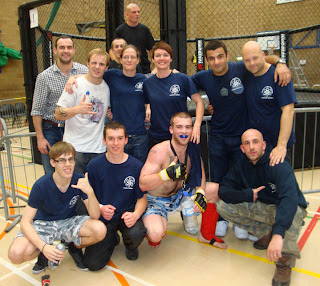
Martyn Cahill (top right hand corner) and the Lab Rats at Take-Down
Martyn Cahill (MC):

My first experience in martial arts was within the Bujinkan Budo Taijutsu system. It consists of nine separate martial arts traditions and includes striking, grappling and weapons training. I am currently a first Dan in this system.

Around 2003 I watched UFC1 on DVD, Royce inspired me to begin training in BJJ. I began training at the Straight Blast Gym in Manchester. Over time I expanded my training to include wrestling and eventually MMA. In 2007 I began to coach some beginners classes and eventually became a certified coach within the SBG organisation. I now run my own classes at The Labs – Fighting Fit in Manchester.

What's your take on MMA?

GB:

MMA to me is the most complete combat sport. I am interested in all combat sports (actually I am interested in most sports!), but the limiting rules in other combat sports make them less interesting overall. I am not saying I like to see fewer rules; I want to see rules set up to make a more fluid, skilful sport. MMA has the closest set of rules to make this the case, rewarding a wide skill set and allowing success through a variety of approaches.

MC:

I enjoy certain aspects of MMA very much. I admit that I prefer a technical fight over a brawl any day. I have a bias toward Jiu Jitsu, it's the art that I love most. To me a submission is beautiful.

Cage vs Ring? Gi training or No-gi training?

GB:

It has to be cage every time. The number of restarts in a ring fight makes it impractical, and ruins the fluidity of a fight. Obviously, we do a lot of training working against the cage fence, which has become an important part of the sport. As soon as this is gone, the sport has lost some of its appeal for me.

I believe both gi and no-gi training is important. For people fighting MMA, I would recommend a slight bias towards no-gi training, but not to neglect the gi. No-gi has more of a focus on speed and scrambling, which are both important, and obviously the gripping options are different. People generally say training with the gi makes you more technical, but no-gi is technical too, but in a different way. I think that the main benefit of gi training is that it forces you to defend attacks at an earlier stage, as there is less chance of slipping or powering out a bit later. Also, it makes positioning more precise, the subtleties of which I didn't realise fully until I trained with Steve Campbell - Manchester's best BJJ coach!

MT:

Cage all the way helps to keep the fluidity of a fight. The ring employs the use of the ref too much and really isn’t as safe as a cage!

The Gi v no-gi is an interesting question. I have spent most my training life doing No-gi but have recently decided to don the Gi for the first time. I have heard all the arguments for and against and to be honest during my MMA fight career I choose to never train in the Gi. I have had students ask me this question and I will always advise them to try both and make up there own mind as it needs to be right for them!

I always chose not to wear the Gi due to my feeling that concentrating on No-gi was far more important for MMA than Gi training. You have a limited amount of training time a week and a lot of different aspects and styles need to be covered, Gi work wasn't as applicable so I chose not to do it.

MC:

I am a big fan of the cage; it's safer for the fighters than a ring and can also be used as a tool by the fighters.

My opinion is that Gi training makes you a better grappler, just look at Roger Gracie and Marcello Garcia. They are perhaps two of the most successful competitors ever; both train in a Gi on a regular basis. However, when it comes to preparation for a MMA match the Gi must be put away for the duration of the training camp. This allows the fighter to adjust his grips etc.


------------------------END OF PART I----------------------


I hope you enjoyed part one. In part two, the Manchester based MMA coaches give us their take on fighter attributes and the component parts of the sport of MMA.


----Did You Like This Article?--- Click here to add The Part Time Grappler to your Favourites / Bookmarks ---------------------------------

Finishing Armbars from Guard in BJJ / Grappling

One thought I always keep in the background when I'm rolling / drilling is: is this the most efficient way to do what I'm doing? While that certainly sounds nice, it can be interpreted in more than one way.

Am I using my whole body?
Am I using too much or too little muscle?
Am I using the right ones and only them?
Am I working 3-4 steps ahead or am I simply reacting to my partner?

And so on. I urge you to come up with a few of your own interpretations.

I was watching an old video, Arm-Locks, and Mr Harris showed a beautiful way to use your whole body and principles from weight lifting (the leg press to be exact) to finish the spinning armbar from guard against the stack. I share that with you here.

They've stacked you and hugged your head. Your back is not strong enough for your legs to push their weight away from you, but your hands are not being utilised


Use both hands on your knees to help you with the difficult first couple of inches. Utilise a popping motion to help push their weight off you.


From there you have a choice of straight-armbarring the near-side arm by pressing down the elbow or just going back to your original armbar on the far arm (with or without throwing them on their back)


Where else in BJJ / Grappling are you leaving a hand or a foot (or a hip or a shoulder or even your head) without use?
Oh, don't forget to visit the Crazy-Ass BJJ Gi Design Challenge Blog and submit your fab designs! Over 1200 visitors can't be wrong.

----Did You Like This Article?--- Click here to add The Part Time Grappler to your Favourites / Bookmarks ---------------------------------

What Body Type Are You?

Right! Here is the Deal! Seymour is wacko, but as with all wackos, he’s also a brilliant artist (or was it the other way around?)

My dear friend Mr Seymour Yang – or as Eddie Kone refers to him: The Meerkat! – asked me to draw myself as I see it (I referred to myself as a T-Rex shape) so, using as crude a drawing implement as possible, (MS Paint) I sent him a pic or two. You can see them here.

He used his daughter's etchasketch thingy. Genius!!!


So what crazy body type are you? Gmail Seymour, and he'll post up your crudely beautiful drawing.


----Did You Like This Article?--- Click here to add The Part Time Grappler to your Favourites / Bookmarks ---------------------------------

BJJ / Grappling tips: Rolling with Beginners

I taught Saturday's No-Gi session at the LABS, covering for Anna. Traditionally, these sessions have a free sparring portion even though some beginners come to them and it's a great chance to roll with complete newbies. I showed two techniques to transition from side control / Reverse Kesa Gatame to mount and the Kimura option if the hand presents itself.

During a roll with a very tall, strong beginner I got to mount using exactly the techniques showed earlier, except he reached up and got me in a headlock. I made sure I thank him after the session and here's why. Only a beginner will do that.


Anyone with a few months of BJJ / Grappling / MMA under their belt will know not to. Which means if you never roll with complete beginners, you'll never work your headlock counters from the mount. Even if you're not training for self-defence, you need to know what to do when someone bigger and stronger puts you in one with full intent to reverse you. Enter Mr Beginner. Thanks!


----Did You Like This Article?--- Click here to add The Part Time Grappler to your Favourites / Bookmarks ---------------------------------

Applying Kotler's Model to BJJ / Grappling Training


When I was studying this morning I came across the Kotler model for classifying products and services in my Social Marketing course book. Philip Kotler is a great Business and Marketing mind and in this model he pits immediate satisfaction against long-term well fare.


Of course the goal is to fill our lives with the Soc called Desirable Products (DesP) and minimise the Deficient Products (DefP).

As always, my mind wondered to how this correlates to BJJ / Grappling.

Desirable Strategies/Techniques/Movements are those that give us high scores on both Immediate Satisfaction and Long-Term Welfare, while Deficient ones would score considerably lower on both scales.

Here is a simple attempt on my behalf to fill in the model:


What would you put in the different fields?


----Did You Like This Article?--- Click here to add The Part Time Grappler to your Favourites / Bookmarks ---------------------------------

Girls and BJJ / Grappling


A couple of articles have been floating around the bloggosphere about women in BJJ / Grappling. One by Steve and one by Allie inspired me to think about the subject, but from different angle.

When the majority opens its doors to a minority, the majority always expects the minority to see things thru the majority's eyes.

This is my own opinion, based on changing countries, clubs, social circles, universities and work places a number of times.

No one can disagree that the majority of BJJ / Grappling players around the world are male, making females a minority.

When women/girls start at a BJJ / Grappling club or academy, the men there expect them to see BJJ / Grappling the way they (the men – the majority) see it.

The day women start voicing that they see things differently (good or bad) then one of the following may take place:

1. The aforementioned majority will think that’s a great thing and welcome the suggestions / ideas / voices / changes
2. They will reject it publicly, cross their arms, mumble like idiots and start quoting rubbish like “sink or swim” and “heat in the kitchen”…etc.
3. They will pay lip service and welcome it publicly but mumble and complain or joke about it privately/on forums/in changing rooms…etc.

I’m glad to say that in my experience, the majority of people have belonged to the first group, with a few short-timers in the 2nd and very few in the 3rd.

Let’s get this straight. You owe me nothing. I owe you nothing. We both owe the mat everything.

The goal is the journey. The goal is to come to the BJJ/Grappling mat regularly and learn and roll and enrich our lives. Any behaviour that adds to and facilitates that is good. . Any behaviour that hinders it is bad. That’s my black & white on the subject.

Personally, I hate rolling with weak people. I just don't understand how it could possible help my game:


----Did You Like This Article?--- Click here to add The Part Time Grappler to your Favourites / Bookmarks ---------------------------------

BJJ / Grappling and Weight Loss Training Tips


Above are my figures as of today, 2 days ahead of the Manchester Open.

Don’t get me wrong; I have not been loosing weight specifically for this event, but rather for the long-term health of my joints and internal systems. I don’t consider myself heavy, but I strongly believe that the less you weigh within healthy parameters the better. There is a lot of research to support that but I just think that it makes sense.

This all started on the 1st of January 2010. I weighed 89kg and felt that I was taking a long time to recover from the weekly BJJ / Grappling sessions. I researched recovery and and found out a lot about rest, protein, carbs, creatine…etc. But everywhere I looked, weight a healthy little was often looked more favourable upon than weighing a healthy lot. That, combined with the Warrior Diet that I’d been following for a few months then, lead me to make a few small changes in my life. I didn’t want to go on a short-term diet or exercise plan. I wanted to take it very slow. Unnoticeably slow. In fact, so slow that I wouldn’t even notice it and therefore not look forward to it finishing (which is the culprit of every short-term diet!)

So what did I do?

-I only ate food that tasted really well.
-I stopped eating crap
-Following the Warrior Diet, I ate fruit and veg thru-out the day* and one meal at night
-I drank lots of water, tea and coffee
-I consumed lots of smoothies. Always homemade.
-I consumed lots of fruit juices. Always, always homemade.
-I used my lunch period at work to burn 300 kcal. 5 times a week. Every week.
-Every time I went to the gym, I recorded my weight and my Body Fat% and kept it on an Excel spreadsheet – without judging it!

I noticed that I was getting results but, as I said above, I didn’t want to judge it. Apart from running a column for the actual figures, I also ran a separate one that gave me averages. So if on day one I had 14kg of fat and on day two I had 14.9, the average would be 14.95…and so on. I did this because my training in Statistics told me that while figures can lie short-term, averages seldom do in the long term. Also, it gave me great consolation around e.g. Valentine’s day when my body fat weight got stuck (or even went up!) by thankfully the average kept creeping down. It was more forgiving and reminded me that a day or two are not the end of the world!

With the gi, I weight about 84kg, which puts me in Medium Heavy (81-87kg). Oh well. It’s all fun and games.

Have a great weekend and if you’re attending the Manchester Open, come by and say hi.

----Did You Like This Article?--- Click here to add The Part Time Grappler to your Favourites / Bookmarks ---------------------------------

The Quickest Way To Improve Your BJJ / Grappling

On Friday I had my first private BJJ session with a new client. These are always very exciting for me because I'm always working on new ways to improve my teaching curriculum and methods but most importantly because I get to spend quality time doing something I love with someone who's obviously very keen on the same topic: getting better at Brazilian Jiu Jitstu.

As with every first session of the introduction pack, we spend a few minutes talking before the session to establish background in BJJ / Grappling but also general athletic background and time they can realistically dedicate to training. We follow this with a 5 minute slow roll where I'm mainly working out the client's energy and pressures. At this stage, I'm not really interested in what they can do from, for example, guard, but rather in HOW they play guard. That's where I see my contribution to be useful. Not in feeding someone new techniques, but rather in giving their existing BJJ game an M.O.T. test!

Naturally, what I discover in those first 5 minutes can vary depending on whom I rolling with but the one most common denominator is often commitment. Roy Harris talks about using your attributes to FUEL your techniques. I like thinking in terms of commitment: Commitment to the position. Commitment to the transition or sweep. Commitment to the armbar, choke or leg lock. Of course, I'm not talking about forcing your way thru muscular strength or speed or power. I'm talking about committing your directional energy and weight and sensitivity. Applying yourself wholly to each and every move. The quickest way to improve your BJJ / grappling experience is to commit your full and undivided attention to it.

Are you playing guard? Don't let your partner settle in your guard. Move their weight around. Deny them their posture or base and watch them give you the armbars, chokes and sweeps.

Are you on side control top? Let them carry your weight. Free your hands and use sensitivity and the outside of your knee to monitor their guard retrieval attempts. Don't just grab hold and squeeze, a little like an ostrich with its head in the sand, but rather apply yourself to what you are doing! Keep you jiu jitsu alive by staying committed.


----Did You Like This Article?--- Click here to add The Part Time Grappler to your Favourites / Bookmarks ---------------------------------

Amazing Balls!

Yes I'm a great advocate of Unstable Base Training but I must admit I've never seen anything like this fella:

Mr Abmar Barbosa training on the Swiss-Ball


This is the man who (amongst many other accomplishments) beat Kron Gracie 11-0!

Can you see why?

A big thanks goes of course to Georgette Oden for directing me to this link.

----Did You Like This Article?--- Make sure you add The Part Time Grappler to your Favourites / Bookmarks ---------------------------------

Tips For Smaller Female Grapplers

That's the title of Stephan Kesting's last Newsletter email (which in it's own right is awesome and should be made compulsory reading!)

You can read the article itself on Grapple Arts, and you can (and should) visit the original author (Krista Scott-Dixon)'s own blog.

While we're on the subject or reading, here is a fantastic little article called the Jiu Jitsu Triangle (but it has nothing to do with the famous choke!)

Happy reading!

----Did You Like This Article?---
Make sure you add The Part Time Grappler to your Favourites / Bookmarks
---------------------------------

BJJ Tips: Wanna Get Better at BJJ / Grappling? What Are You Gonna Do About It?

On my way to work I listened to yet another excellent podcast by the Fightworks Podcast. The conversation in mind was with Pedro Sauer black belt Keith Owen. It was a great interview and, as great interviews do, it inspired a few questions in me:
  1. Apart from training at your gym/academy/school…etc., do you do any training on your own (attributes/technique)?
  2. Do you watch BJJ / Grappling material analytically?
  3. Do you read BJJ / Grappling material analytically?
  4. Do you research ways to improve your diet and supplementation?
All these questions revolve around one central theme:

In what way(s) are you taking ownership of getting better at the sport/art/endeavour you love so much?


Those of you who have been following this blog may now that I'm no believer in "discipline" or "sacrifice" and that my Buddhist inspiration automatically makes me more "NOW" and "experience" driven than "plans" and "future" so I'm not asking what do you hope/wish/plan on doing, adding, incorporating or stopping...etc. in order to understand and play BJJ / Grappling better, but rather what ARE you doing now?

Rather than try to live in the what-could/should/ought to-be, live in the what-is.

Above is a picture I took of my little daily lab. Every day that I go to the gym, I play with these tools to understand more about BJJ / Grappling. I don't do it because I should or ought to or even because someone recommended it. I do it because it makes me happy and because I see my favourite hobby in a different light.

How about you? Play much?

----Did You Like This Article?---

Drop me a line on parttimegrappler@ymail.com or explore some of the recommended past articles on the right...


BJJ Tips: Using Strength to Fuel Technique

How embarrassing! Every weekday morning I go to a shop at the station to buy some cottage cheese or yoghurt before taking the train to work. I usually pay by card and use the self-service checkouts for speed and today was no different. Only today no matter how many times I pressed on that damn ENTER button it wouldn't take the payment. I called the dude who works there and he did the same thing only this time it worked!

He then looked me up and down and said: "you have to press stronger, sir. "I couldn't restrain myself from laughing. I had a Grappling-Grasshopper moment at Sainsbury's!

Using strength had become such taboo that we sometimes refuse to use it in its rightful place: to fuel mechanically correct techniques. A perfectly executed triangle choke will still need that final squeeze to make it work. After you have blocked your partner's path and broken their posture, you will still need that final push to sweep them and of course, once you’ve scanned all your items, placed them in the collection area and put your visa card in the reader "you have to press stronger, sir."

----Did You Like This Article?---

Drop me a line on parttimegrappler@ymail.com or explore some of the recommended past articles on the right...

Brazilian Jiu Jitsu Tips: The Importance of Attributes in BJJ / Grappling


Tori, the crazy gym manager at the onsite gym at work had the great idea to have a sponsored row on the two ConceptII rowers we have. Participants were to do half an hour each and they would be paired up. I showed up on time, did a quick warm up and then jumped on the rower. I pulled and pulled and maintained a good pace. Being a little competitive, I kept glancing at my colleague’s pace (strokes / second) and was very happy that I was maintaining a higher one.

At the end of the row our screens flashed with the total distance covered and my jaw just dropped. He had covered a considerable distance further than me. I turned to Tori with a dropped jaw and a big “Quoi?” on my forehead. She was quick to explain that because he was 4 inches taller or so, he would row further. For every stroke, even if his pace was slower.

How unfair. Beaten by simple attributes!

It reminded me that you can’t ignore the importance of attributes in BJJ / Grappling and of an excellent article by Roy Harris. I hope you enjoy reading it.


----Did You Like This Article?---

Drop me a line on parttimegrappler@ymail.com or explore some of the recommended past articles on the right...