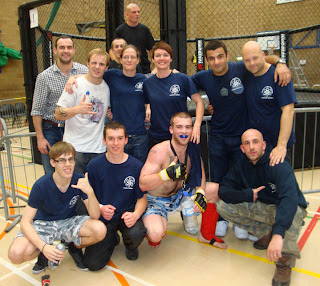
WOW!! What an amazing response the interviews received! Who knew people from places as far as New Zeeland and Argentina would be interested in the Manchester MMA scene! Many thanks to all who took the time to read (and even send emails!) my interviews with head coaches Mr Gavin Boardman - Manchester Predators MMA, Mr Matt Thorpe - 12Gauge MMA and of course our own Mr Martyn Cahill - The Labs - Fighting Fit.
Here is part II of the interviews.
What's your take on the athletes’ attributes (physical and mental)?
Gavin Boardman (GB):

That's a very vague question. Doesn't that cover everything?! The attributes are what make a fighter. We all learn the same things, and are generally coached the same way. Everything else then must be the attributes of the individual athlete. The success of a fighter is quite often very little to do with his/her coach. I take no credit for any wins, only responsibility for all losses.
Matt Thorpe (MT):
They are both an important part of making a fighter or competitor. I would argue that mental is more important than physical, if you have a weak mind it doesn't matter how technically brilliant or physically gifted you are you just aren't going to cut it! I have spent a lot of time working with sport psychologists when I was fighting so I know how important having a strong positive mind is. This is something we incorporate into a fighters training camp and is massively important during the warm up before a fight!!
The physical side of things are a little different there are many sides to it, obviously being gifted great athleticism is awesome but with time, effort and dedication any one can develop high levels of skill and compete at a high level. If we break down the physical attributes into striking, wrestling and grappling these need to be trained equally in order to become a complete fighter. I do believe though that you have to concentrate a lot on the glue in the middle which is the wrestling and clinch. Without this whether you are a striker or grappler you can't dictate where the fight takes place!! I also believe this to be the most tiring of the 3 aspects, with striking and ground work you have time for a breather where as the wrestling and clinch side of things as neither competitor has established dominance yet you tend to find it is like to bulls butting heads!! Which brings us to breaking down the physical side of things into strength, power and fitness again these are all massively important and should be incorporated into the competitors training plan with a proper periodized program.
Martyn Cahill (MC):
There are many different kinds of fighters in terms of their physical and mental approach to the sport. Some people are very aggressive and rely more on their natural attributes, some are more technical and reserved. It is impossible to say which is better, in the end it is all down to the individual. I think perhaps the most successful fighters are those that manage to find the right balance for them between the two extremes.
What are the most important 3? How are they trained best?
GB:
The most important is what many people refer to as gameness. The ability to step up no matter how tough the situation seems. To a large degree this can't be trained, you either have it or you don't. You can toughen up training with hard sparring, but once you get in the cage it might not be there for you.
Second, I would say the ability to learn. We are involved in such a complicated sport; there is so much to learn. And things change in this sport quickly. If you can’t get up there and then keep yourself there, you will struggle. The coach has a responsibility in ensuring he adapts his approach to the needs of the athlete, but again largely a natural ability.
The third, I will say is the ability to listen under pressure. Being able to filter out useless information and listen to a game plan is much harder than people think. It is important to zone in on your coach's voice in training sessions through the sounds of other people training and through the bad music, so that it is natural in competition.
If you are looking for physical attributes in the list, there importance varies along with the style and approach of the fighter. Also, it seems like I am saying that the most important attributes are natural and can't be trained. Well that's why coaches have less to do with a fighter’s success than some make out. All we do is make sure they are ready to compete, set out an appropriate game plan, and adapt that game plan as necessary.
MT:
Difficult question to answer really as everyone is different. As a coach you need to assess each individual separately and decide what they need to work on to improve and reach the goals they are striving for!
MC:
For me the most important attributes are a good work ethic, creativity and mental fortitude. Things such as technique and conditioning can be worked on but I think the attributes I chose have to already be within a person. There are just some things that you can't coach; of course they can be encouraged.
Creativity for example is simply developed by providing the athlete with the correct tools. That is why I focus on fundamentals and the principles behind the techniques and that's one of the reasons our club is called The Labs!
Do you see MMA is a stand-alone sport or as a hybrid of individually trained arts?
GB:
I see it as a stand-alone sport. As much as I love BJJ or Boxing, the techniques have to be adapted for MMA. The best fighters don't flow between different arts, all of these "arts" exist at once. You can't throw a boxers left hook while adjusting your base to a wrestler's stance to level change for a double. Left hook to double just happens from 1 stance and is a standard movement in MMA.
MT:
I see MMA nowadays as a stand-alone sport. Yes it takes a lot of different things from a lot of different arts but they still have to be tweaked in order to use them within MMA. Striking for MMA, Wrestling for MMA and groundwork for MMA are different to any of the individual sports and have to be trained accordingly.
MC:
MMA is to some extent still a group of individually trained sports. You still see guys going to train in Thailand on their Muay Thai or working with a conventional boxing coach or wrestling coach. I'm sure lots of people will disagree with me but I generally do not like this approach. I just think that too many adjustments have to be made for these systems to then be reincorporated back into an individual’s game. I prefer to work on striking that is going to facilitate my grappling or grappling that is geared towards allowing me to strike effectively. The ultimate goal is to achieve seamless transitions between the three elements of stand-up, clinch and ground.
I take it you watch a lot of MMA. What impresses you in a fight?
GB:
I generally have the same view watching any sport. I am impressed with technical ability and tactical awareness. In that respect I like my MMA as I like my football.
MT:
I do watch a fair bit of MMA, what probably impresses me the most in a fight is a well-executed gameplan. I have seen fights won by guys that shouldn't have won by a very cleverly executed gameplan. It is something that can be under utilised by fighters so it is impressive to see a coach and fighter develop a plan that wins them a fight.
MC:
I get impressed in MMA by lots of things. The bravery and heart of a lot of these athletes is amazing. The amount of hard work and sacrifice they are willing to put into their preparation is second to none. I really appreciate a technical fight; I'm not a great fan of slugging it out.
How much of a role does diet play?
GB:
Diet is a major part of any fighter's success. Especially with the importance of weight cutting, and coming in as heavy as possible at the weight while maintaining optimum performance. Also, training day to day requires a focus on diet that most of us can't get close to.
MT:
Correct nutrition plays a massive role in your fighters conditioning it can have a massive impact improving their overall performance. I have spent a lot of time studying sports nutrition and it is something that I sit down with all my fighters and discuss, putting a proper plan in place. Nutrition is a subject all coaches and fighters should have knowledge of especially in a sport that is so heavily full of weight cutting, if this is done incorrectly it can have a very negative impact on your fighters performance and can be extremely dangerous.
MC:
First of all I'll say that I am not an expert in nutrition so my opinion is just that, an opinion. I imagine that diet plays a huge role in the preparation of any athlete. Not only for the repair and recovery of the body but also to maintain weight at a chosen level and to provide adequate energy during training. We have far more qualified people at our gym to discuss such matters so I will leave it to the experts.
Share with us a funny training anecdote or story.
GB:
Have you heard the one about the black belt and the trannie......lets leave that for another day.
MT:
Recently I brought my coach and good friend Aaron Chatfield in to teach a session on elbows. After demonstrating a technique he left the guys practicing, as they where doing this he was explaining how effective an accurate elbow can be and that it will slice you open like a razor. As this was occurring one of my students proceeded to miss the pad completely landing the elbow perfectly down the forehead of his partner slicing him open, this proceeded to piss blood all over the floor and his face my coach then turned around and said "See, Lethal!!". I had to take him home so that his wife could take him to hospital where he had to have 6 stitches to repair the damage.
MC:
Hmm nothing really springs to mind regarding a funny training anecdote. All the guys at the gym are really nice people, we all get on well and the atmosphere is very relaxed. People are constantly joking around and giving each other a hard time so it's hard to select on particular instance.
Finally, where and how can people get hold of you?
GB:
In the gym is the easiest place, alternatively my contact information is on the
Predators website.
MT:
You can check out the
clubs website and email me at matthew.thorpe@12gaugemma.com
MC:
Our BJJ-No gi-MMA classes are at the Labs – Fighting Fit Manchester. You can find us in city centre just down the road from the Urbis and Victoria train station. This is our Google-Map location and you can also find us on Facebook.
Once again, many thanks guys!
What an awesome bunch. If you are into MMA and you live in Manchester (or just visiting) then get in touch with Gavin, Matt or Martyn and drop down for a BJJ, No-Gi or MMA session or two. Who knows, you might even like it!
The Manchester MMA scene is in good hands.
----Did You Like This Article?---
Click here to add The Part Time Grappler to your Favourites / Bookmarks ---------------------------------